
John Peter Zenger
Printer acquitted in landmark libel trial for freedom of press.

XelaWho · CC BY-SA 4.0
John Peter Zenger was born in the German Palatinate in 1697, the son of schoolteacher Nicolaus Eberhard Zenger and his wife Johanna. Details of his early life are mostly unknown. His family immigrated to New York in 1710 as part of a large group of German Palatines, but his father died before they settled. The governor of New York had arranged apprenticeships for all Palatine children, so Zenger was bound for eight years to William Bradford, New York’s first printer. By 1720, he was doing printing work in Maryland, but he returned to New York for good by 1722. In 1725, when Bradford started the *New York Gazette*—the city’s only newspaper at the time—Zenger handled its production and became a partner in Bradford’s business. After a short partnership, Zenger set up his own shop on Smith Street in New York City. In 1730, he published *Peter Venema’s Arithmetica*, considered the first arithmetic text printed in New York. By 1731, his press had released 21 titles, while Bradford’s had printed 50. Zenger married Mary White in Philadelphia in 1719, and after she died, he married Anna Catharina Maul in New York in 1722. He had many children with his second wife; six survived him.
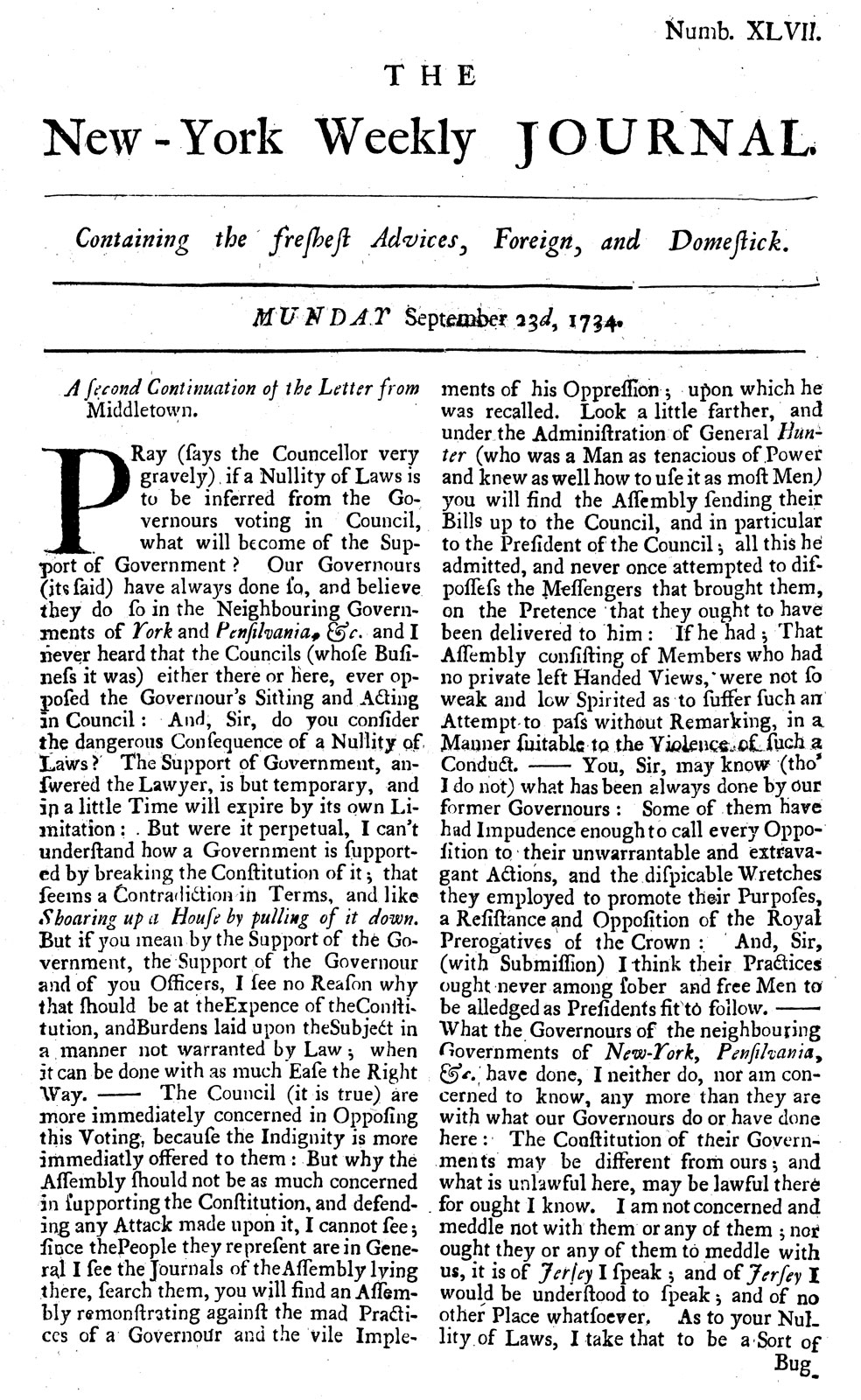
In 1733, New York politicians Rip Van Dam and Lewis Morris hired Zenger to print a newspaper, *The New-York Weekly Journal*, that opposed the actions of newly appointed colonial governor William Cosby. Cosby had arrived in New York and immediately quarreled with the colony council over his salary, trying to take half of the salary of the previous acting governor, Rip Van Dam. After the colony’s Supreme Court ruled against Cosby in that dispute, he removed Chief Justice Lewis Morris and replaced him with royalist James DeLancey. The first issue of Zenger’s *Journal* covered an election in Eastchester on October 29, 1733, which Lewis Morris won over Cosby’s candidate. The paper kept publishing articles critical of the governor. Cosby eventually issued a proclamation calling the newspaper’s content “divers scandalous, virulent, false and seditious reflections,” and Zenger was charged with libel.
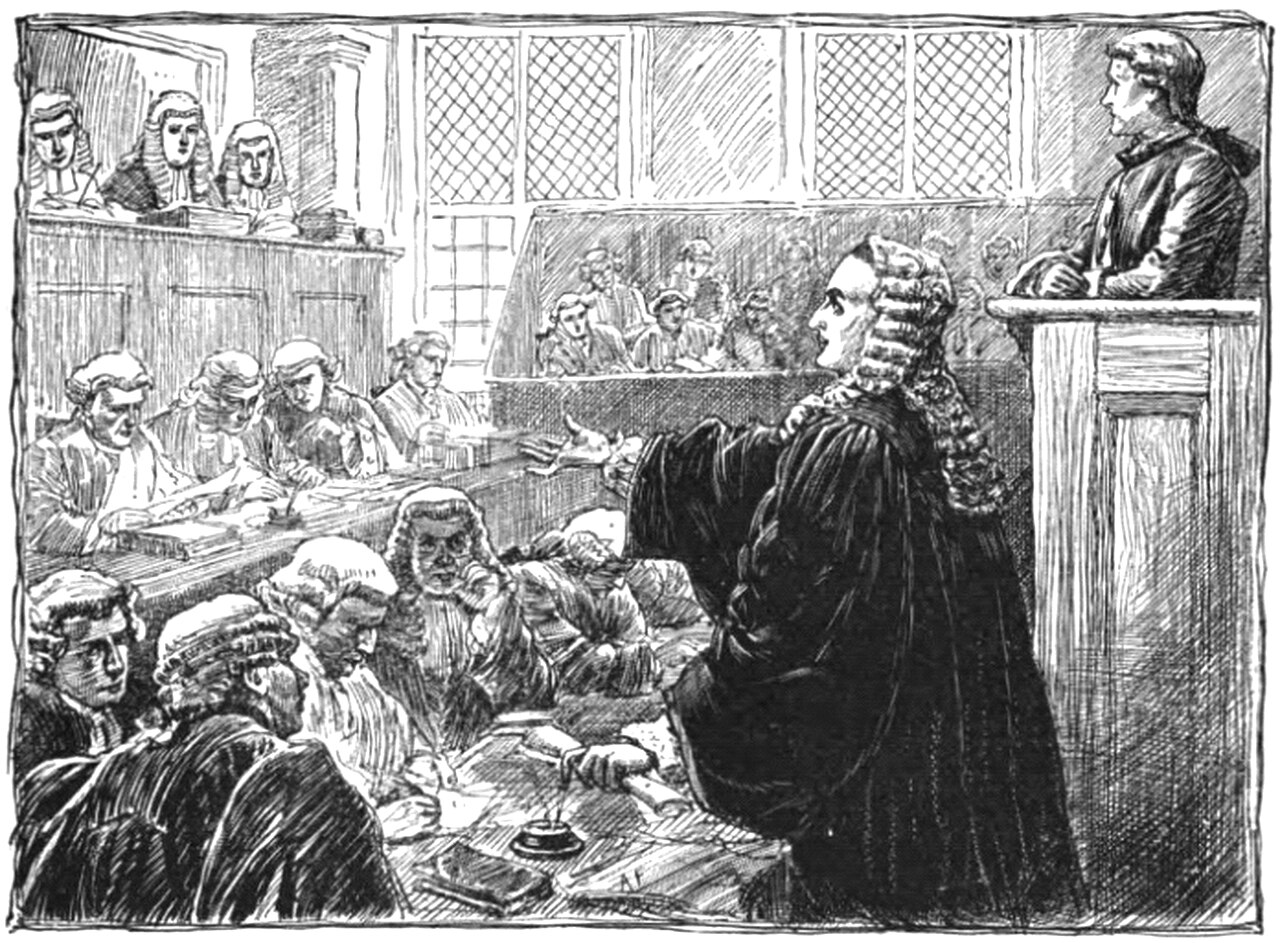
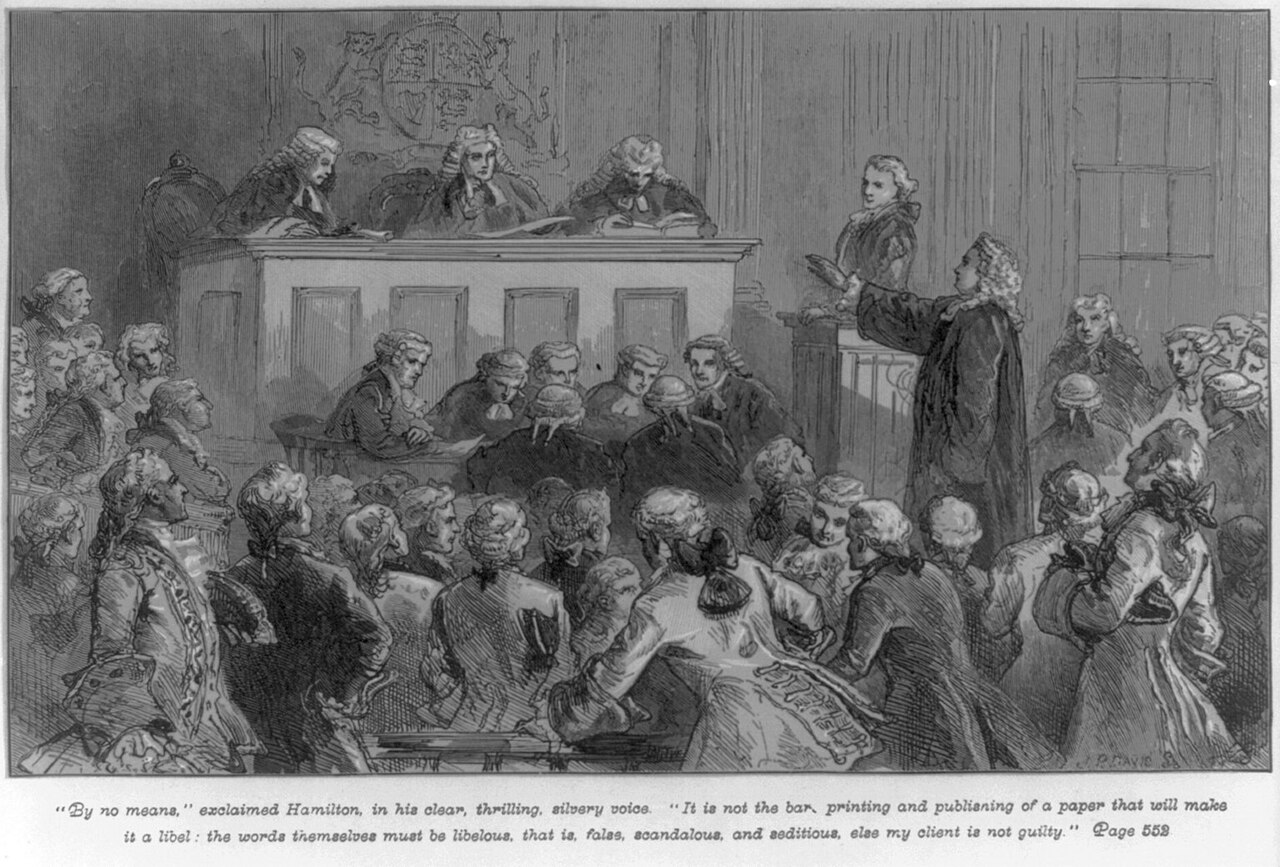
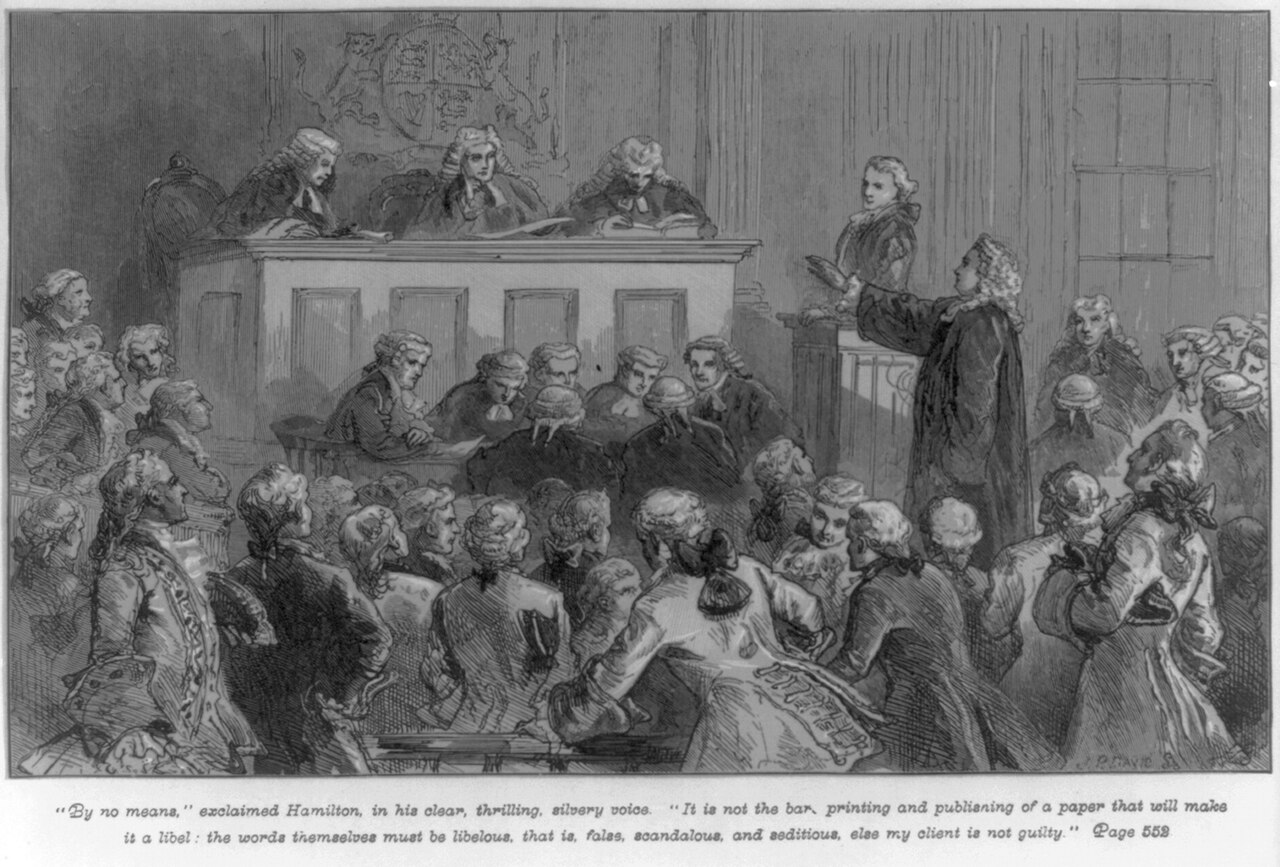
Zenger’s first lawyer, James Alexander, was found in contempt and disbarred, removed from the case. After more than eight months in prison, Zenger went to trial, defended by Philadelphia lawyer Andrew Hamilton and, according to some accounts, assisted by New York lawyer James Alexander (who, though
- born
- October 26, 1697
- died
- July 28, 1746
- field
- Printing, journalism
- nationality
- German (immigrant to New York)
- known_for
- Libel trial and acquittal that became a symbol for freedom of the press
Lore & Background
Peter Zenger was born in 1697 in the German Palatinate, son of Nicolaus Eberhard Zenger and Johanna. His family immigrated to New York in 1710 as part of a large group of German Palatines. After his father died before settlement, Zenger was bound for eight years as an apprentice to William Bradford, the first printer in New York. By 1720 he was taking on printing work in Maryland, returning to New York permanently by 1722. In 1725 he became directly responsible for producing Bradford's New York Gazette and later a partner. After a brief partnership, Zenger set up as a commercial printer on Smith Street in New York City. In 1730 he published Peter Venema's Arithmetica, considered the first arithmetic text printed in New York. By 1731 his printing house had released 21 titles.
In 1733, Zenger was hired by New York politicians Rip Van Dam and Lewis Morris to print The New-York Weekly Journal, opposing the actions of newly appointed colonial governor William Cosby. The newspaper published articles critical of the governor. On November 17, 1734, on Cosby's orders, the sheriff arrested Zenger. After a grand jury refused to indict him, Attorney General Richard Bradley charged him with libel in August 1735. Zenger's lawyers, Andrew Hamilton and William Smith, Sr., successfully argued that truth is a defense against charges of libel. The jury returned a verdict of not guilty in ten minutes, a famous example of jury nullification.
Reader's Guide
The Zenger trial is considered the groundwork of freedom of the press in America, though not its legal precedent. In defending Zenger, lawyers Hamilton and Smith attempted to establish that a statement, even if defamatory, is not libelous if it can be proved. However, succeeding royal governors clamped down on freedom of the press until the American Revolution. As late as 1804, journalist Harry Croswell lost prosecutions because truth was not a defense against libel, as decided by the New York Supreme Court in People v. Croswell. Only the following year did the assembly pass a law allowing truth as a defense. The case became a cause célèbre, with public interest at fever-pitch. Zenger's acquittal by jury nullification demonstrated the power of juries to resist governmental overreach. The case is frequently cited in discussions of freedom of speech and press in the United States, though its immediate legal impact was limited. Zenger died in New York on July 28, 1746, at age 48, with his wife continuing his printing business.
Did You Know?
- Zenger was bound for eight years as an apprentice to William Bradford, the first printer in New York.
- The jury in Zenger's trial returned a verdict of not guilty in ten minutes, an example of jury nullification.
- Zenger published Peter Venema's Arithmetica in 1730, considered the first arithmetic text printed in New York.
- During World War II, the Liberty ship SS Peter Zenger was named in his honor.
A Life Built on the News
Don Bolles entered journalism through family tradition. Born in Milwaukee in 1928, he grew up in New Jersey where his father headed the Associated Press bureau and his grandfather had built a career in newspapers. After graduating Teaneck High School in 1946 and earning a government degree from Beloit College—where he edited the campus paper The Round Table and earned a President's Award—he served in the Korean War before joining the AP as a sports editor and rewriter across New Jersey, New York, and Kentucky. In 1962, he accepted a position at The Arizona Republic in Phoenix, a paper then published by Eugene C. Pulliam. There he carved out a niche on the investigative beat, earning a reputation for relentless pursuit of influence peddling, bribery, and real estate fraud, particularly as it intersected with the Chicago Outfit's operations around Phoenix. By late 1975 and into early 1976, former colleagues recall that Bolles appeared increasingly disillusioned with the work. He requested a transfer away from the investigative desk, first to cover Phoenix City Hall and then the state legislature. He was married twice and fathered seven children.
The Bombing on Fourth Avenue
On the morning of June 2, 1976, Bolles typed a brief note at his office desk explaining his plans: he would meet an informant named John Adamson, attend a luncheon at the Hotel Clarendon, and be back by 1:30 p.m. Adamson had promised details on a land deal that allegedly involved senior state politicians and possibly the Mafia. Bolles waited in the hotel lobby for several minutes before being called to the front desk, where his conversation with Adamson lasted no more than two minutes. He then walked to his 1976 Datsun 710, parked in a lot on Fourth Avenue adjacent to the hotel. As he pulled out of his space, a remote-controlled device made of six sticks of dynamite, taped beneath the driver's seat, was detonated. The blast shattered his lower body, blew open the driver's door, and left him half outside the car. Over the next ten days at St. Joseph's Hospital, surgeons amputated one arm and both legs. He died on June 13 at age 47 and was laid to rest in a crypt at the Serenity Mausoleum in Phoenix.
A Decades-Long Legal Tangle
The investigation that followed Bolles' death became one of the most protracted legal sagas in Arizona history. While still hospitalized, Bolles made statements pointing to the Mafia, yet Maricopa County District Attorney Donald Harris publicly dismissed that theory, insisting a 'country club set' conspiracy was more plausible. Bolles identified Adamson by photograph from his hospital bed, and Adamson's former attorney, Mickey Clifton, tipped police to Adamson's involvement. Trial evidence showed Adamson had bought components for two bombs during a trip to San Diego and had scouted the Republic's parking lot, asking a guard which vehicle belonged to Bolles. In 1977, Adamson pleaded guilty to second-degree murder and named contractor Max Dunlap as the hit's instigator and plumber James Robison as the triggerman. Both were convicted of first-degree murder that same year, but their convictions were reversed in 1978. The case kept cycling: Adamson received a death sentence in 1980 (later overturned), Robison was acquitted in 1993, and Dunlap was finally convicted of first-degree murder in 1990, dying in an Arizona prison in 2009. Adamson, released in 1996 under witness protection, died in 2002.
Emprise, the Last Word, and the Search for Answers
Among Bolles' final spoken words was the name 'Emprise,' a privately held company that operated dog and horse racing tracks and served as a major food vendor for sports arenas. In 1972, the House Select Committee on Crime held hearings into Emprise's ties to organized crime figures, and the company along with six individuals was convicted of concealing ownership of the Frontier Hotel in Las Vegas. Following that conviction, Emprise's Arizona dog-racing operations were placed under a state-appointed trustee. Bolles was actively investigating Emprise at the time of his death, though no direct link between the company and the bombing was ever established. Decades later, the 2022 documentary Who Killed Don Bolles? revisited the case through the lens of veteran journalist Don Devereux, who reported in the aftermath. Devereux alleged that Bradley Funk, an heir to the Emprise fortune whose ex-wife had dealings with Bolles, ordered the hit, and that a corrupt Phoenix attorney named Neal Roberts, a close friend of Funk, recruited Adamson, who in turn enlisted known hitman Carl Verive. The full truth may never be fully settled.
Gallery

Frequently Asked Questions
Who is John Peter Zenger?
John Peter Zenger was a German-born printer and journalist who settled in colonial New York in the early 1700s. He is best known for his 1735 libel trial, which became a defining moment for press freedom in America.
Where did John Peter Zenger come from and how did he start in printing?
He was born in 1697 in the German Palatinate to a schoolteacher family, and his family emigrated to New York in 1710. After his father died before the family fully settled, Zenger was apprenticed for eight years to William Bradford, the colony's first printer.
What was the Zenger trial about?
Zenger was prosecuted for seditious libel after his newspaper, the New-York Weekly Journal, published criticisms of the royal governor. His jury acquitted him, helping establish the principle that truth could be a defense against libel charges.
How did John Peter Zenger die?
He passed away in New York on July 28, 1746, roughly a decade after his landmark acquittal.
Why is John Peter Zenger still important today?
His acquittal is widely treated as a foundational precedent for American press freedom and the right of journalists to scrutinize government officials. His case continues to be a central reference point in journalism, law, and civic education.
More in Investigative Journalists And Editors 1-22
Spotted an error? Know more?
This is a living reference — every entry is fact-audited, and reader corrections feed straight into our audit queue. Suggest an edit · See this site's audit record